The Roma movement is nobody’s private property!
The situation of Roma in Bulgaria deserves serious concern. While thousands of people continue to face poverty, unemployment, educational inequality and political marginalisation, certain self-proclaimed authorities remain occupied with congresses, titles, photographs and internal disputes.
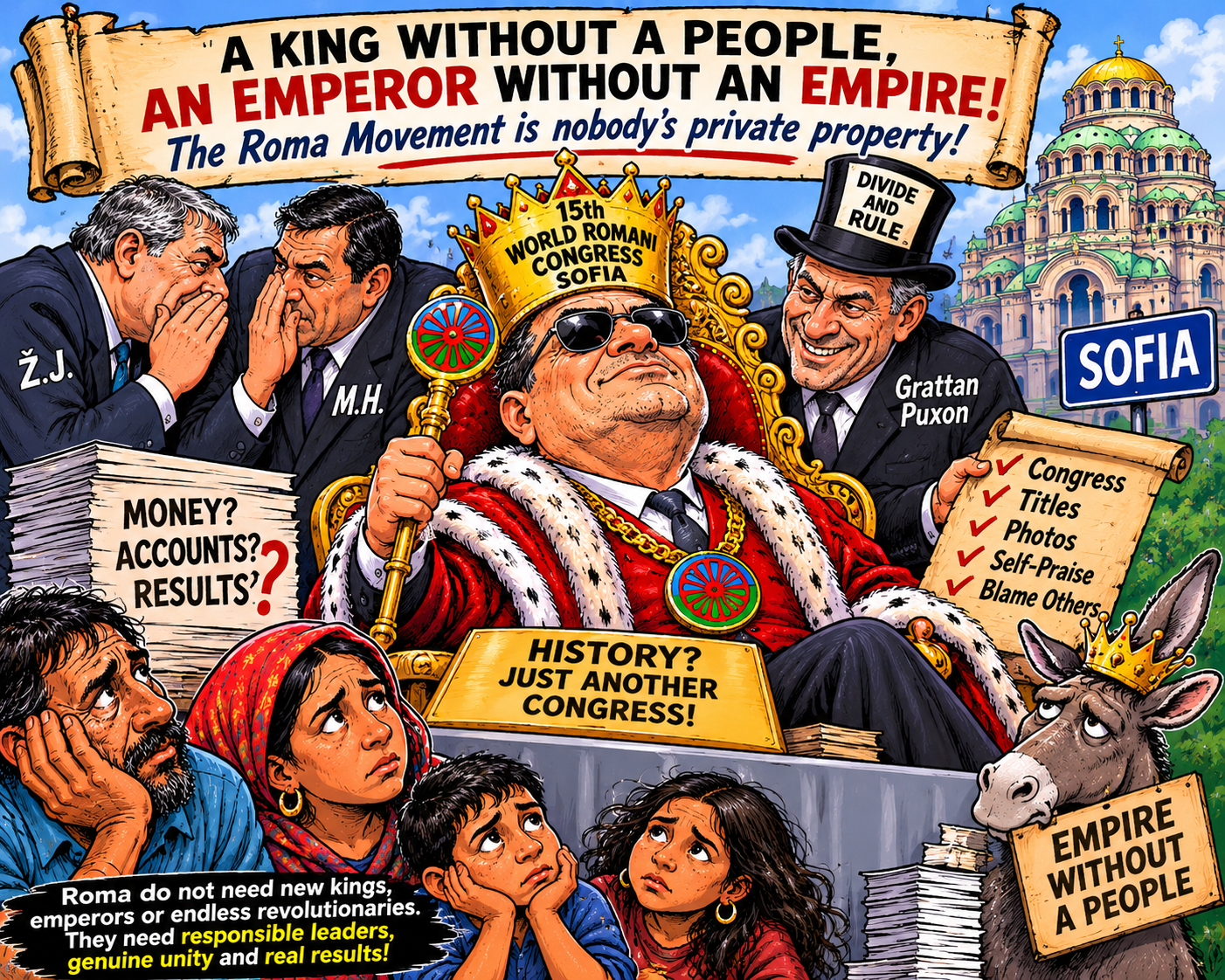
A particularly satirical episode is the so-called 15th World Romani Congress in Sofia. Apparently, today a world congress no longer requires historical continuity, broad democratic support or clear institutional legitimacy. All it takes is to gather a group of people, set up a table, take a few photographs and add a Roman numeral. If this practice continues, soon every city will have its own world congress, every organiser their own parliament, and every participant an opportunity to leave with a historical title. The people, however, will remain where they are – without a voice, without representation and without results. But the Roman numeral XV is no magic wand capable of creating historical continuity overnight.
A particular example is Grattan Puxon, with his long-standing anarchistic methods, repeated old narratives, caricature-style publications and constant attempts to present himself as a historical authority. Yet behind every self-proclaimed strategist, there are sometimes invisible mentors. In this story, influences from certain circles can also be recognised, represented by the initials Ž.J. and M.H. Apparently, there are more directors behind the scenes than actors on the stage, and everyone wants to hold the conductor’s baton.
His political recipe seems simple: first create divisions, then blame others, and finally present yourself as the only saviour. Divide and rule – except that this time there is neither a real kingdom nor a people who have given anyone a mandate to rule.
And when the show ends, the second act begins: who spent how much, who owes whom, and who is supposed to return the money. Now, even England is expected to provide some kind of solution to problems created by the organisers themselves. But financial accountability cannot be settled through social media posts and accusations; it requires documents, transparent accounts and responsibility.
Today, anyone can organise a congress, award themselves a title and declare themselves a king or an emperor. But what is the value of a royal crown without a people behind it? A king without a people is merely a man wearing a paper crown, while an emperor without an empire is just a title in his own imagination.
The greatest irony is that while some are fighting over historical titles and personal prestige, ordinary Roma in Bulgaria are still waiting for real change. The Roma movement is nobody’s private property, nor is it a house deed that can be transferred according to personal interests.
Roma do not need new kings, emperors or eternal revolutionaries on social media. They need responsible leaders, genuine unity and concrete results.
Because history is not built with caricatures, legitimacy is not obtained through self-proclamation, and a people cannot be led through photographs and self-praise.
Those who do not know how to build unity should stop presenting themselves as builders of Roma history!